
Jurassic Park Changed Everything
On wonder, terror, and what it means to watch the impossible happen in real time

It’s difficult for me to write about Jurassic Park. It’s the film that made me fall in love with cinema. I’ve lived with this movie for thirty years and I have been meaning to put pen to paper for a long time. Spielberg’s masterpiece changed cinema forever, and so I have to go back to where it all started: 1993, because there’s my life before Jurassic Park, and my life after.
My dad picks me up from school and tells me we’re going to watch Jurassic Park tonight. I’m six. I have no idea what it’s about, movie trailers didn’t play often enough back then for it to stick to my six-year-old brain. He picks up a newspaper and scans the showtimes. I glance over and see the iconic poster: a dinosaur skeleton with that memorable typography. I don’t know what “Jurassic” means, I’m not even sure I know what dinosaurs are… But I’m at that age where seeing my parents excited is enough to get me excited, and I can tell my dad is hyped so I’m hyped.
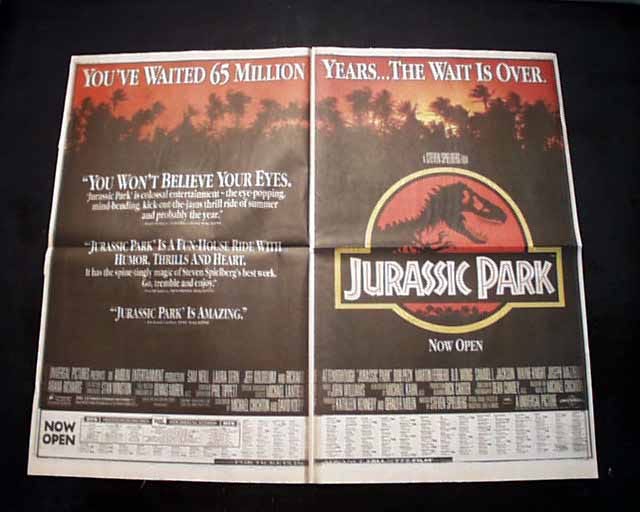
Everything about Jurassic Park was a marketing masterstroke. It was all teasers, the poster was just a logo, no leaks, no set photos, no dinosaurs in the trailers. We all walked into Jurassic Park without seeing what the real stars looked like… Imagine walking into Avengers without seeing the heroes. Spielberg was protecting the film’s most valuable asset: the audience’s first look.
We drop off my backpack, grab a quick dinner, and take the subway to our local theater in Paris. We step out of the station and I’ve never seen it like this… the line isn’t just snaking in front of the theater, it extends across multiple shops and past our metro stop. A sea of adults waiting in line and I’m just a little kid in the middle of all of it. To quote Ian Malcolm: What have they got in there, King Kong?
We get in. We grab our seats. The lights go down. The Universal logo rolls in. John Williams kicks us off with that moody theme as the title appears. I still don’t know what I’m in for, but it’s already hitting different than the Disney movies I’ve been raised on. The next two hours turned that night into one of the most memorable moments of my childhood.
I. Welcome to Jurassic Park
The film opens with a flash of chaos: a container is being moved, an animal is inside, all you see is an eye. It’s the same trick as the shark’s fin in Jaws. Spielberg isn’t going to reveal his cards right away. That opening was just enough to grab my interest: what is going on? What are they moving? Why is it attacking?
Jurassic Park is structured like a theme park ride: the first 45 minutes are pure set-up, Spielberg is just walking you up the ramp before the drop, and he puts you, the audience, inside the same experience as his characters. When Alan Grant, Ian Malcolm, and Ellie Sattler pile into the tour vehicles, they are as impatient as the viewer… we’re all leaning forward: what is this place? Real-life dinosaurs? That doesn’t make any sense! You might as well be in the park with the characters, because you're feeling the exact same thing.
And that’s why the Brachiosaurus reveal is pure movie magic.
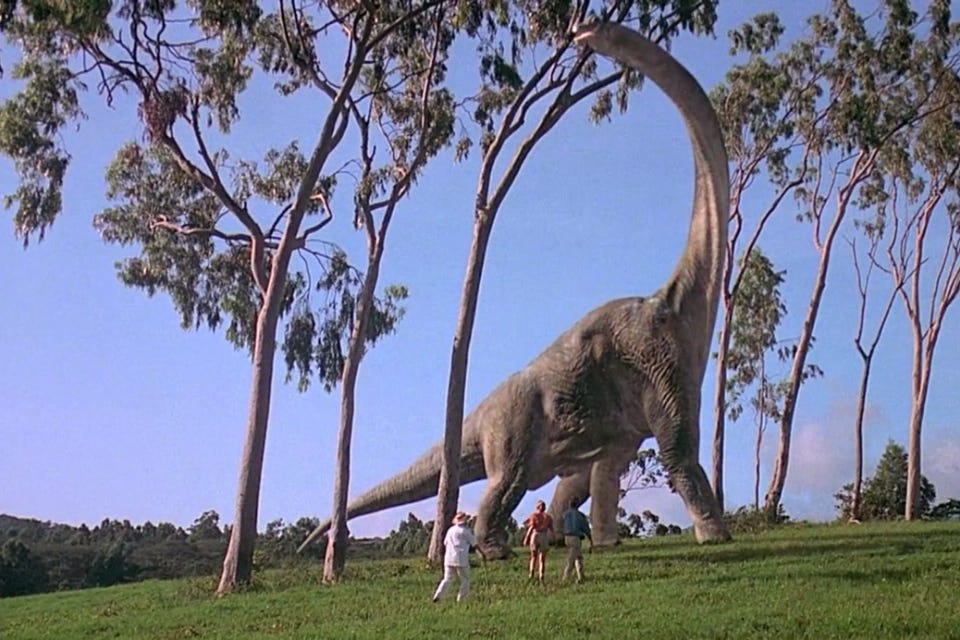
I have to provide some context for anyone that’s younger than me, back in 1993, we had never experienced anything like Jurassic Park. Had we seen dinosaurs? Sure. But it was all puppetry, stop-motion, and men in suits… it was always clearly fake. CGI existed but never at this level of quality and scale. So when that Brachiosaurus appears, our reaction is once again the same as the characters: I don’t believe my eyes, how is this possible?
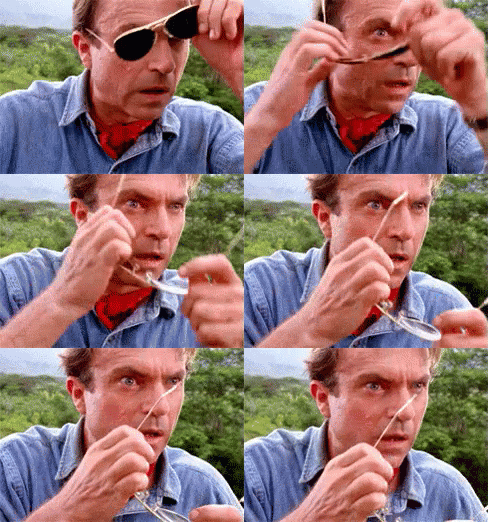
The camera is low to the ground. The scale is enormous. The John Williams theme swells. Grant drops to his knees. Ellie’s jaw falls open. Malcolm just laughs… and Spielberg does what he does better than any director: he lets their belief become your belief. Their shock and awe sells the reality better than any visual effect ever could. I believe that Brachiosaurus is real because the characters believe she’s real. I believe dinosaurs have come back to life because Williams’s moving score tells me a miracle just happened.
That moment is the precise reason no Jurassic Park sequel can ever match the wonder of the first one. For the characters, it’s their first time seeing dinosaurs come to life. For audiences in 1993, it was the first time we believed in the unbelievable. No sequels can top that, because nothing can top your first time.
You get the Brachiosaurus, and then Spielberg pulls back and serves us a series of appetizers before the main course: the baby Raptor hatching from its egg, Grant leaning on the belly of the sick Triceratops as she breathes in and out… it’s all tactile, intimate, and real enough to touch. Then we reach the Dilophosaurus enclosure. It’s empty. The anticipation builds right back up. We want to see more! To quote Malcolm once more: You do plan to have dinosaurs on your dinosaur tour, right?
II. Hold Onto Your Butts
Hitchcock said: “There is no terror in the bang, only in the anticipation of it.” That’s what makes the T-Rex attack one of the all-time great set pieces, because the anticipation is suffocating: the cars stop. It’s raining. The goat is there and then it’s gone. The water trembles in the cup. A bloody leg hits the windshield. The power lines come down. Gennaro sprints to the bathroom… and then we get the BANG, and to contradict Hitchcock, the bang is much more terrifying than all the masterful tension.
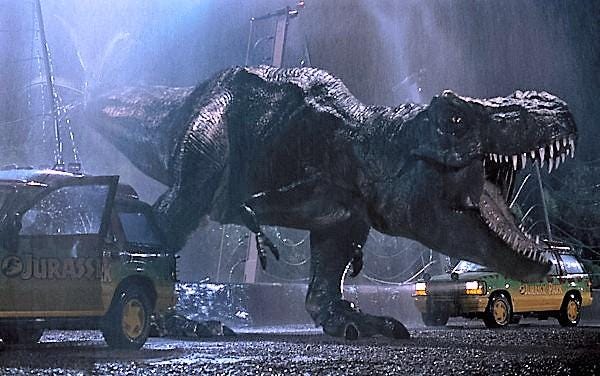
The T-Rex steps out, drawn to Lex’s flashlight, nudging the car like a toy before diving headfirst through the plexiglass. The kids are terrified but it’s Ariana Richards’ piercing screams that sells the attack, you could tell me there was an actual T-Rex on set that day and I’d believe you. Grant tries to distract the T-Rex while Ian makes his own rescue attempt. The restroom gets demolished and Gennaro goes out like a Looney Tunes character: on the toilet, pants around his ankles, he’s our first victim and it’s played for laughs... Timmy is trapped under the car, drowning in mud. Don’t move. He can’t see us if we don’t move. But T-Rex doesn’t play around and before you know it, Grant and Lex are dangling off the cliff, dodging the falling car by a hair.
I still remember gripping my seat tight, as if I was on a rollercoaster.
The T-Rex attack alone is why Spielberg is my favorite filmmaker. Yes, the sequence is a milestone in cinema history, but everything from the camerawork to the blend of CGI and practical effects, to the actors’ reactions is a testament to the power of great art. Watching it for the first time felt like an out-of-body experience, I was speechless. This leap in visual effects was like going to Mars before we’d even landed on the Moon. It’s been 30 years and I’ll never forget how I felt during that set piece: what am I experiencing right now? Is this even real? Is this a dream? Is it a nightmare? That feeling is what I chase every time I sit down for a new movie.
And the ride doesn’t stop after the T-Rex attack. Spielberg is relentless.
Nedry’s scheme goes sideways. He’s stuck in the rain and the Dilophosaurus plays with him to the point where you’re almost charmed… before you know it she spits in his face and I can still hear his wailing screams. 1993 was the first year I wore glasses, so that scene scarred me then and still haunts me today.
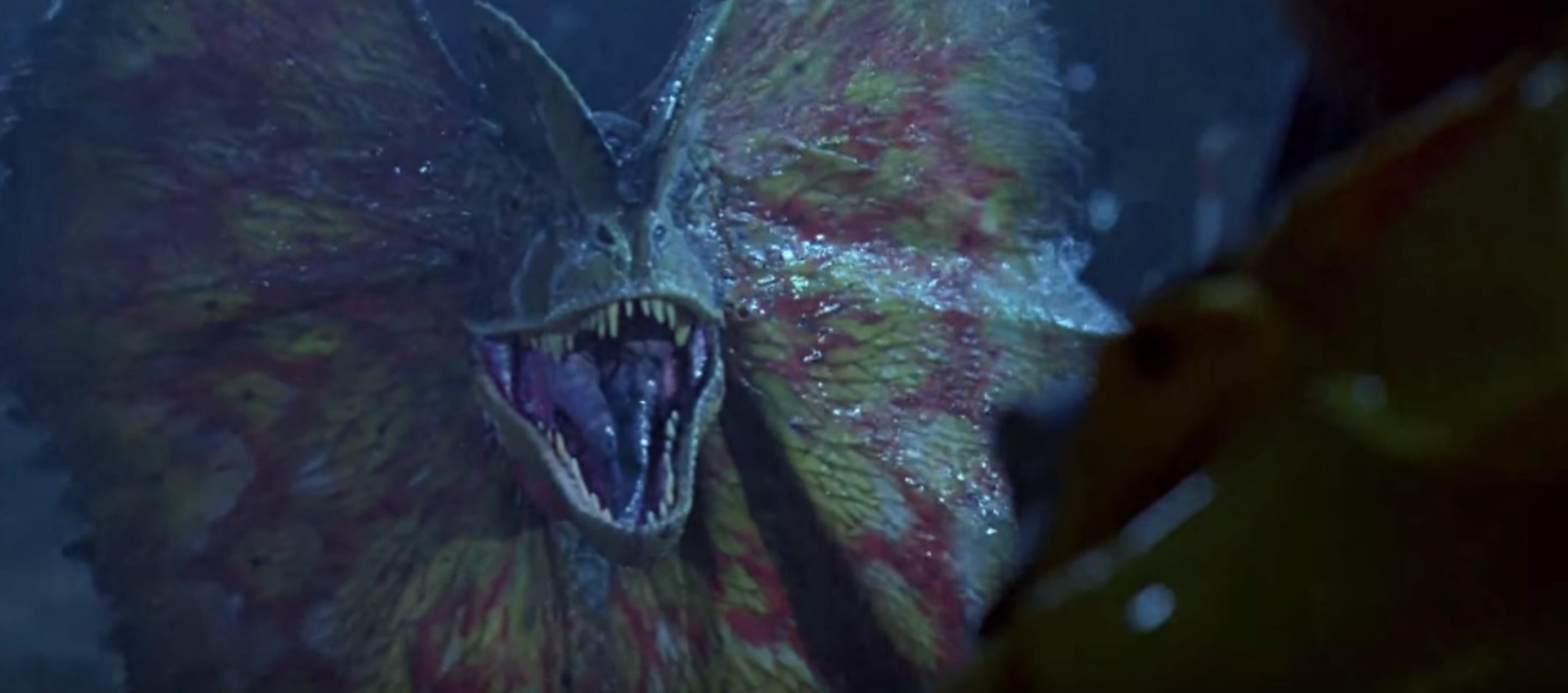
Then the Gallimimus herd stampedes: they’re flocking this way. Muldoon stalking a Raptor, quad muscles engaged, only to turn and find he’s the one being hunted: clever girl. Ellie fighting off a Raptor in the basement, reaching for the breaker switch and finding Dr. Arnold’s severed arm instead of the rest of him. Please Spielberg, let us catch our breath, it’s too much!
And then the Raptors break into the kitchen… if the T-Rex attack was Spielberg showing us the impossible, this is him just flexing: oh you were impressed by my one big dinosaur attack? Here you go, two fast-moving dinosaurs going at it in an enclosed space, enjoy!
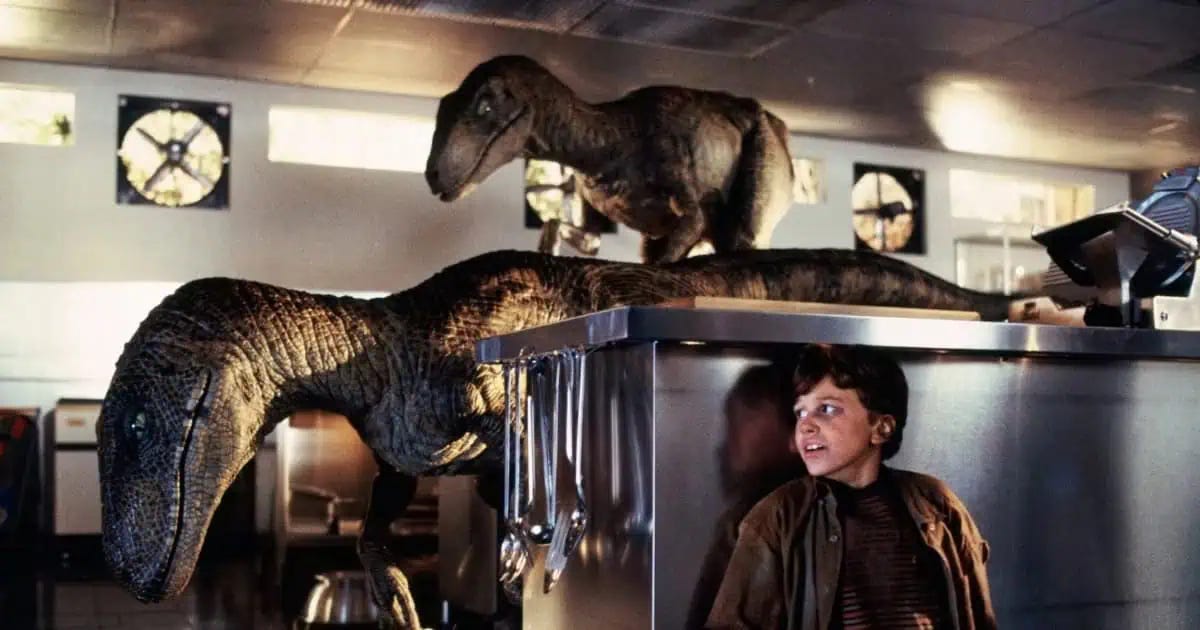
The Raptors are smart enough to open doors! Claws are tapping on the floor. A ladle hits the tile. One of them jumps on the counter. Lex’s reflection tricks one a Raptor into slamming herself into a metal drawer. Once again, the year is NINETEEN NINETY-THREE, our best video games could barely do 3D. How does any of this look so real? You don’t have time to ask. The computer hacking scene, the door locking right as the Raptors’ claws slip away. The escape through the ceiling. Lex’s leg dangling as a Raptor leaps up to snatch her, Grant pulling her free with inches to spare.
Our ending is a convenient deus-ex machina, the T-Rex comes out of nowhere and saves the day. The banner rolls over her as she roars. Sure it’s a leap in logic, but I guarantee nobody watching it for the first time thought: excuse me, where did the T-Rex come from? You’re so bought in you can’t imagine a more satisfying final note. That’s filmmaking at the highest level: making you feel so much you forget to think.
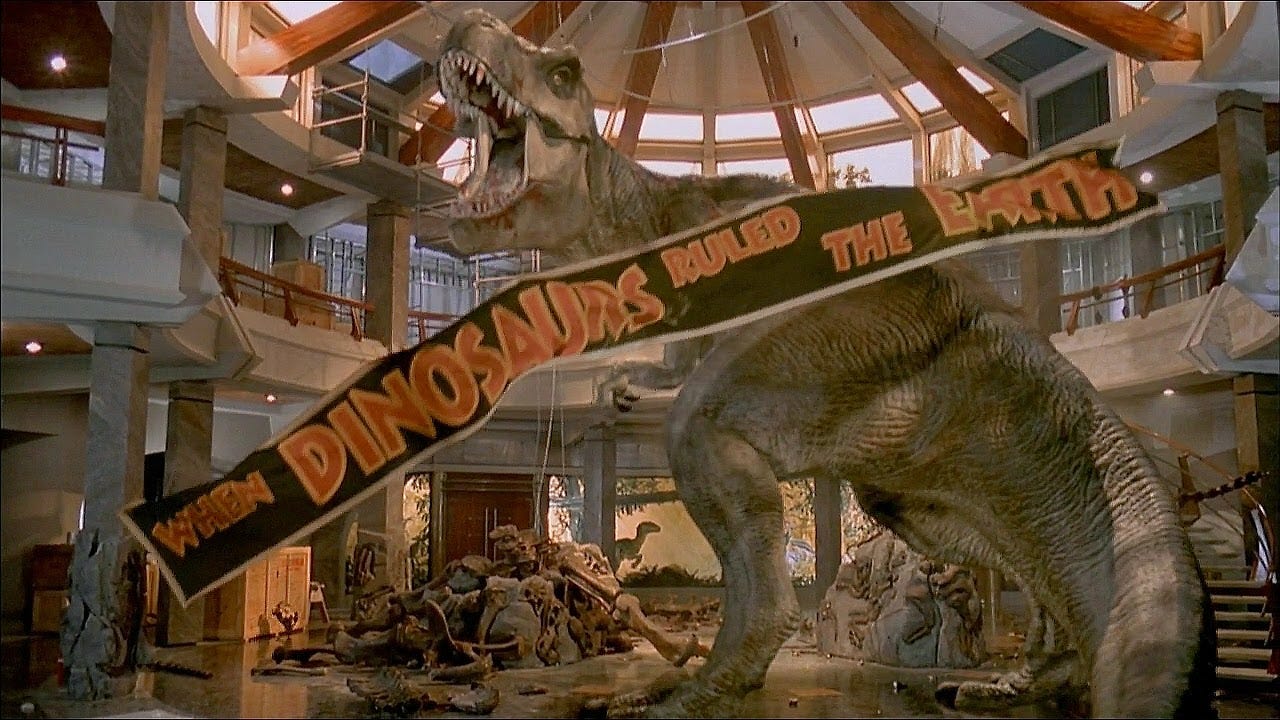
End of ride. Roll credits. The lights come on. I catch my breath. The lady sitting in front of me tells my dad I’d been kicking her chair non-stop. My bad lady, I legit forgot we were in a theater for the last two hours.
III. Life Finds a Way
Needless to say, Spielberg sold the illusion so completely that our culture couldn’t contain it inside the theater… Jurassic Park became a smash hit and dinosaurs became my entire personality. I had toys, video games, clothes, posters, books. I suddenly wanted to become a paleontologist, so we now had museum trips where I gave my parents lectures on dinosaur names and diets. I even read the think pieces that genuinely asked whether we could bring dinosaurs back to life.
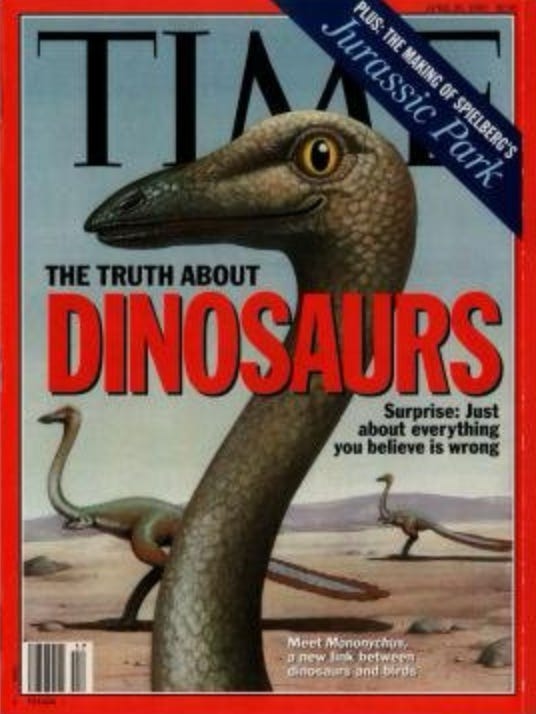
I watched the film seven more times in theaters that year alone. The VHS came out and watching it became a ritual as I wore out the tape and memorized the dialogue.
My dad, a movie buff himself, saw what had happened to me and leaned in. You like Jurassic Park? Watch this. He introduced me to Spielberg’s full catalogue: Jaws, Indiana Jones. Indy led me to Lucas and Star Wars. Spielberg led me to Zemeckis and Back to the Future. It all eventually took me to Coppola and Scorsese which opened my world beyond dinosaurs, sci-fi, and fantasy… Forget paleontology, I now wanted to become a movie director, and it all started with Jurassic Park. I can trace a direct line from that night in 1993 to every film I’ve loved.
IV. I wanted to show them something that wasn't an illusion, something that was real, something that they could see and touch
There's a meta-angle to Jurassic Park that often gets lost in all the discourse: the creation of the dinosaurs in the movie is a direct metaphor for the CGI breakthrough in Hollywood. Hammond doesn’t fully understand what he’s made. He just knows it’s magnificent, and believes the spectacle justifies itself. The scientists warn him but he doesn’t listen. Spielberg is Hammond. He built a cautionary tale about technological hubris into his own celebration of it… and since the film became the highest grossing movie of all-time, we’re all the tourists who came to the park.
Every great visual effect that came after: Star Wars Special Edition, Casper, the full CG revolution of the late nineties and beyond, arrived in a world where Jurassic Park had already changed what was possible. And that's both the miracle and the tragedy of what Spielberg made: you can never get that first feeling back. That first watch made us question the nature of reality. The genie was out of the bottle. Hollywood learned the wrong lesson from it by over-relying on visual effects, mistaking the spectacle for the magic instead of understanding they were never the same thing.
The sequels, for the most part, never understood this. I’ll give credit where it’s due, The Lost World is better than people admit, and Jurassic Park III is a lean little side adventure. But the Jurassic World series learned the wrong lessons: dinosaurs as friends, dinosaurs as monsters, dinosaurs as product. No awe, no wonder, no majesty.
If I’m being honest about where the franchise should go: forget another sequel. Give me a tight, Andor-style series set during the construction of the original park… think of the corporate drama and the ethical debates, with Hammond as the ruthless businessman and visionary. It would barely have any dinosaur action, but if you’ve read the Crichton novel, you know that story is fascinating. Go back to basic. The magic of the original was that Spielberg made you feel like you were seeing something impossible for the first time. If Andor made us fear the Empire again then maybe a Jurassic Park origins story can make us believe in dinosaurs again.
My most recent rewatch of Jurassic Park was my wife’s first time since she was a kid. Watching her go through it was its own experience: she grabbed my hand during the T-Rex attack and pressed her nails into my skin while I laughed like a maniac, and I realized something: I have this film memorized and know every beat before it lands, and yet watching someone I love experience it gave me something close to the original feeling back. The magic still holds, not because of nostalgia, but because of the craft: Spielberg's camerawork, the blend of CGI and practical effects that still hasn't been topped, and Williams going god-mode on that score.
Is it any surprise Jurassic Park became the biggest movie ever made? It’s a film about the miracle of bringing impossible things to life, released at the exact moment cinema first made that miracle possible, directed by the one filmmaker who understood that wonder and terror are the same feeling arriving from different directions. Of course we lost our minds.
Jurassic Park is the reason I wanted to become a movie director when I was younger. Today it’s the reason I care enough about cinema to write about films in the first place. I have a kid on the way now, and I think about this a lot: how do I recreate that feeling for him? I don’t want to force it. It might not even be Jurassic Park that does it, it’s probably something that hasn’t been made yet. But whatever it is, I want him to have that moment where a film leaves a mark on his life and creates memories that he’ll carry forever, the same way my dad did for me thirty-three years ago.
I don't think you need to do a prequel. I'd love to see a story of someone working at a modern Jurassic World after the events of the previous movies, and having to cope with collecting a necessary paycheck from a cheap capitalist company after he just saw a coworker get eaten on the clock. Dinosaurs bringing on late stage capitalism, and the one guy in denial about it.
Great read. I was in middle school when the movie came out. My friends and I all had our parents take us to the theater and were just blown away. It's been probably been decades since I've seen the original. Think a rewatch is due. Even if you lose some magic by it not being on the big screen.